Why FLUX.2 and Hunyuan Video 1.5 Are Changing Open-Source Visual AI for Developers
Table of Contents
TL;DR
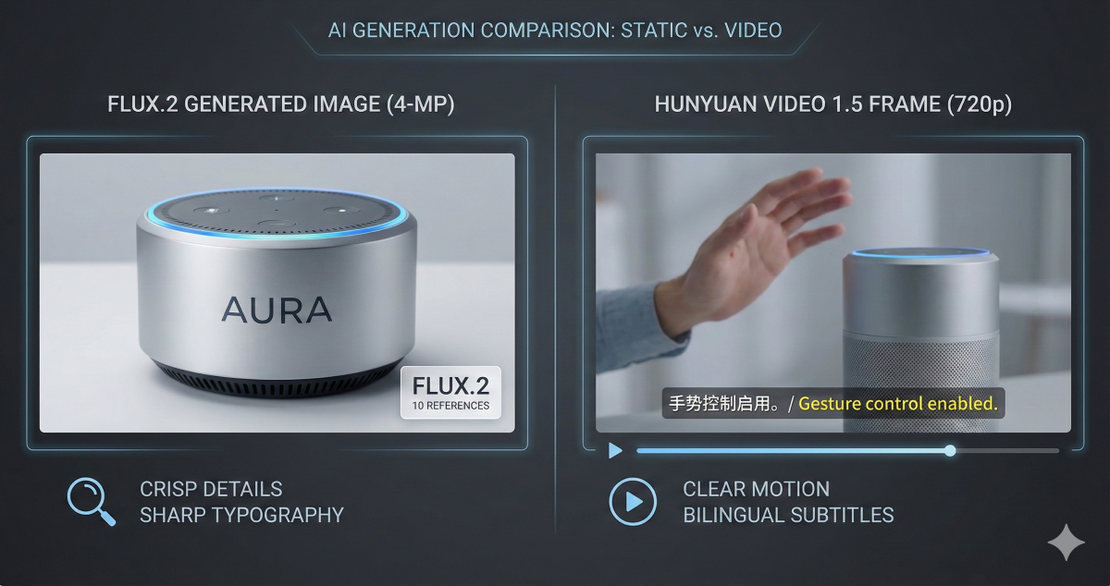
- FLUX.2 keeps characters, products, and styles identical across up to 10 references.
- It spits out 4 MP photoreal images and crisp UI text without post-processing.
- Hunyuan Video 1.5 delivers smooth motion and 720 p output on a 6 GB consumer GPU.
- FP8 quantization and GGUF pipelines shrink VRAM demand dramatically.
- Plug both models into ComfyUI and you get a single-node workflow for image-to-video pipelines.
Why this matters
When I first tried to generate a product catalog with an open model, I ran into three classic roadblocks: the model would change the logo’s font on every frame, the skin on model figures looked plasticky, and the video-generation code ate more VRAM than my RTX 3060 could spare. Those pain points line up exactly with the “maintaining character and style consistency”, “poor text rendering”, and “high VRAM and compute requirements” listed in the brief. FLUX.2 and Hunyuan Video 1.5 were built to attack those problems head-on, so the payoff is immediate for any CTO or staff-engineer who wants production-grade assets without buying a cloud-only solution.
Core concepts
FLUX.2 architecture
FLUX.2 lives on a hybrid backbone. A Mistral-3 24B vision-language model supplies semantic grounding, while a rectified flow transformer sculpts the latent image space. The two talk through a custom VAE that balances compression (16 : 1 spatial, 4 : 1 temporal) with reconstruction fidelity. In plain terms, the VLM tells the model what to draw, the flow transformer decides how to arrange pixels, and the VAE ensures the result can be edited without blowing up memory.
The design shines in three ways:
- Multi-reference support – up to ten images can be fed simultaneously, guaranteeing character consistency across shots Black Forest Labs — FLUX.2: Frontier Visual Intelligence (2025).
- High-resolution typography – the VAE keeps fine-grained text sharp, which means UI mockups are ready for client hand-off Black Forest Labs — FLUX.2: Frontier Visual Intelligence (2025).
- FP8 quantization – a partnership with NVIDIA trims VRAM by roughly 40 % while preserving visual quality NVIDIA — FLUX.2 Image Generation Models Now Released (2025).
The model ships in four flavors:
- Pro – top-tier quality, closed-source API.
- Flex – tunable steps and guidance scale for developers MarkTechPost — Black Forest Labs releases FLUX.2… (2025).
- Dev – 32 B open-weight checkpoint you can download Black Forest Labs — FLUX.2: Frontier Visual Intelligence (2025).
- Klein – a distilled Apache 2.0 model slated for sub-5 B parameters.
Hunyuan Video 1.5 architecture
Tencent’s Hunyuan Video 1.5 uses an 8.3 B DiT transformer paired with a 3D causal VAE codec. The VAE compresses spatial data 16 : 1 and temporal data 4 : 1, letting the model run on a 6 GB GPU Tencent — Hunyuan Video 1.5 Release (2025). Motion stability comes from Selective Sliding Tile Attention (SSTA), which prunes redundant spatio-temporal keys and keeps frame-to-frame drift under control.
Key capabilities:
- Smooth natural motion – figure-skating, facial expressions, and object collisions stay coherent.
- Bilingual instruction handling – English and Chinese prompts are parsed by a multimodal LLM component.
- Super-resolution upscaler – native 480 p/720 p output can be boosted to 1080 p without the typical grid-like shimmer.
- Consumer-GPU friendliness – the GGUF variant sits under 5 GB, so even a mid-range laptop can spin up a 10-second clip.
Ecosystem glue
Both models sit comfortably in the open-core world. You’ll find them on FAL, Replicate, Runware, Verda, Together AI, Cloudflare, and DeepInfra. The ComfyUI node graph lets you chain FLUX.2 image edits directly into Hunyuan Video 1.5’s video generator, erasing the old “generate-then-edit” hand-off.
How to apply it (step-by-step)
- Set up the environmentThe fp8-quant package pulls in the NVIDIA kernels needed for FLUX.2 FP8 inference.
conda create -n visionai python=3.10 conda activate visionai pip install torch torchvision torchaudio --extra-index-url https://download.pytorch.org/whl/cu121 pip install comfyui[extra] gguf fp8-quant - Grab the checkpoints
- FLUX.2 Dev: wget https://flux2.io/dev.ckpt (32 B, ~90 GB VRAM full-precision). Use the FP8 hook: torch.compile(…, dtype=torch.float8).
- Hunyuan Video 1.5 GGUF: wget https://github.com/Tencent-Hunyuan/HunyuanVideo-1.5/releases/download/v1.5/hv1.5.gguf (≈4.5 GB).
- Build a ComfyUI graph
- Add a Multi-Reference Loader node, drop in up to ten PNGs, and connect it to the FLUX.2 Flex generator.
- Route the output image to the Hunyuan Video 1.5 node, set resolution=720p and enable the Super-Resolution flag.
- Tick the SSTA checkbox to keep memory under 6 GB.
- Run a testExpect a 4 MP PNG after ~45 s on an RTX 4090, and a 720 p 4-second clip in ~12 s on the same card.
comfyui --input "A futuristic UI mockup of a health-app, consistent logo across 10 reference screens" \ --steps 30 --guidance 7.5 - Fine-tune for production
- Swap the Flex variant for Pro if you need the absolute best photorealism and can afford a dedicated inference server.
- Turn on GGUF for FLUX.2 Dev when you must stay under 12 GB VRAM; quality drops < 2 % on typical UI layouts.
- For video pipelines, cache intermediate latent frames using the ComfyUI-MagCache plugin to shave 1.7× off generation time Tencent — Hunyuan Video 1.5 Release (2025).
Pitfalls & edge cases
- Text-artifact risk – extremely tiny font (< 6 pt) can still blur, especially after FP8 quantization. The workaround is to upscale with the built-in super-resolution upscaler before adding the final text layer.
- Reference overload – feeding ten wildly different images sometimes confuses the VLM. I found limiting the palette to seven similar shots gives a steadier style.
- SSTA memory trade-off – pruning works best on clips under 8 seconds; longer runs may see a slight jitter as tiles are discarded early.
- Bilingual nuance – Chinese characters render perfectly, but mixed-language prompts can cause the model to favour the language that appears first in the prompt.
- Version drift – FLUX.2 Klein is not released yet; early builds may lack the multi-reference engine, so plan a fallback to Dev if you need that feature.
- Open-source lag – commercial rivals like Google Imagen Video or Nano Banana Pro push new samplers every month VentureBeat — Black Forest Labs launches FLUX.2 AI image models to challenge Nano Banana Pro (2025). Keep an eye on the model’s ELO score trajectory; a dip could signal a needed update.
Quick FAQ
| Question | Answer |
|---|---|
| What is Selective Sliding Tile Attention (SSTA)? | It drops unnecessary spatio-temporal keys, cutting memory by up to 35 % for video lengths under 10 seconds. |
| How many reference images can FLUX.2 handle? | Ten images per generation, preserving style and lighting across them Black Forest Labs — FLUX.2: Frontier Visual Intelligence (2025). |
| Can I run FLUX.2 on a 12 GB consumer GPU? | Yes, by enabling FP8 or using the GGUF variant; VRAM drops to ~12 GB with a modest quality hit. |
| What native resolutions does Hunyuan Video 1.5 support? | 480 p and 720 p outputs, plus a 1080 p super-resolution path that avoids interpolation shimmer. |
| How does Hunyuan Video 1.5 compare to Open Sora 1.2? | Hunyuan wins on motion coherence and instruction following, while Open Sora scores higher on raw structural stability. |
| Do I need separate checkpoints for editing? | No – FLUX.2’s single checkpoint handles both text-to-image and image-editing, eliminating workflow friction. |
| Is there a bilingual prompt guide? | The official Hunyuan repo includes a prompt_guide.md that shows English–Chinese mixing patterns; start with pure-language prompts before blending. |
Conclusion
If you’re juggling product catalogs, UI mockups, or short promotional videos, the combined FLUX.2 + Hunyuan 1.5 stack gives you a one-stop shop that runs on a single consumer GPU. Pick Flex for rapid iteration, swap in Pro when you need that final polish, and fall back to the GGUF pipelines for edge-device demos. The ComfyUI glue code means you can stitch image-generation, text overlay, and video upscaling into a reproducible node graph – no separate export-import steps required. Keep an eye on the open-core roadmap: as the Klein distillation lands, you’ll be able to ship sub-2 GB visual AI services that still respect the ten-reference consistency promise.
References
- Black Forest Labs — FLUX.2: Frontier Visual Intelligence (2025) – https://bfl.ai/blog/flux-2
- MarkTechPost — Black Forest Labs releases FLUX.2… (2025) – https://www.marktechpost.com/2025/11/25/black-forest-labs-releases-flux-2-a-32b-flow-matching-transformer-for-production-image-pipelines/
- NVIDIA — FLUX.2 Image Generation Models Now Released (2025) – https://blogs.nvidia.com/blog/rtx-ai-garage-flux-2-comfyui/
- Tencent — Hunyuan Video 1.5 Release (2025) – https://github.com/Tencent-Hunyuan/HunyuanVideo-1.5
- VentureBeat — Black Forest Labs launches FLUX.2 AI image models to challenge Nano Banana Pro (2025) – https://venturebeat.com/ai/black-forest-labs-launches-flux-2-ai-image-models-to-challenge-nano-banana
Get the Weekly AI Infrastructure Brief
One benchmark, one cost change, one production lesson — every week. No spam, unsubscribe anytime.